
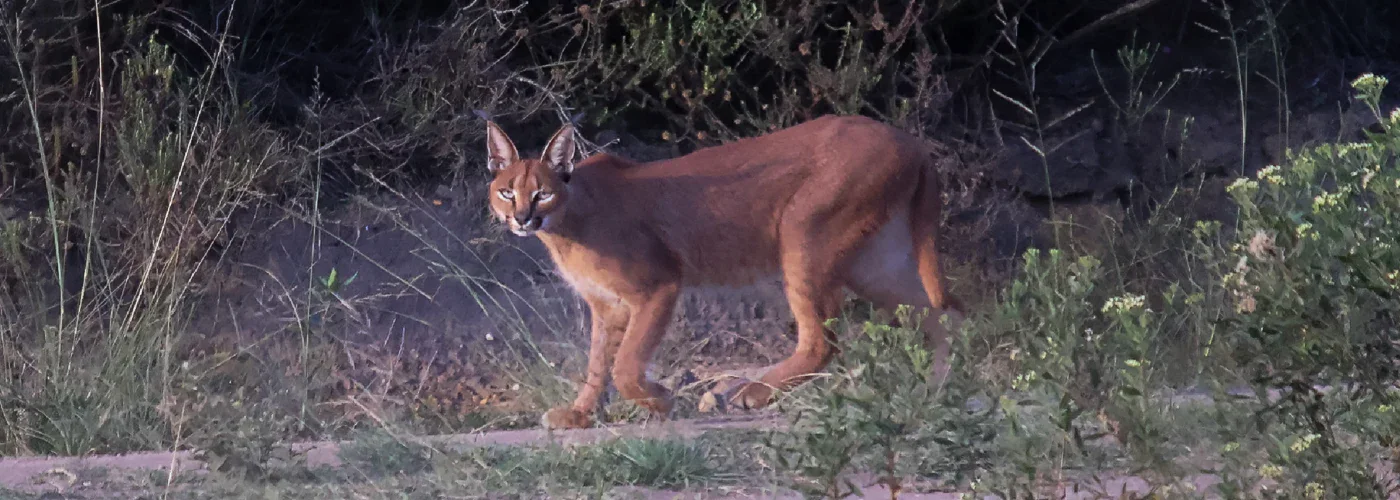
29 May Wildlife Spotlight: The Caracal (Rooikat) at Botlierskop
When guests think of a safari experience, iconic species such as lion, elephant, buffalo, rhino and leopard often take centre stage. Yet some of the most fascinating wildlife sightings happen quietly, often unnoticed.
At Botlierskop Private Nature Reserve, we celebrate not only the famous Big Five, but also the extraordinary lesser-known species that contribute to the balance and beauty of the ecosystem. One such animal is the elusive and remarkable caracal, also known in South Africa as the rooikat.
Recently, a mother caracal and her kittens were spotted on the eastern side of the reserve, a rare and special sighting that highlights the importance of protected habitats for these magnificent wild cats.
What is a Caracal
The name caracal originates from the Turkish word karakulak, meaning “black ear”, a reference to the animal’s striking pointed ears tipped with dramatic black tufts.
The caracal is a medium-sized wild cat found across parts of Africa, the Middle East and Asia. In South Africa, it is commonly known as the rooikat due to its reddish coat. Despite sometimes being called a “lynx,” it is not a true lynx species. Caracals are primarily solitary and territorial, much like most feline species.
Adult males patrol extensive territories, marking boundaries with scent and defending them from rival males. Male territories are often significantly larger than those of females and may overlap with several female ranges.
Although caracals are generally nocturnal, they may also be active during the day in areas with minimal human disturbance — meaning lucky guests at Botlierskop occasionally get a glimpse of one.
How to Identify a Caracal
The caracal is instantly recognisable once you know what to look for.
These elegant cats have:
- Long, muscular legs and a powerful build
- A short tail
- Reddish to sandy-coloured fur for camouflage
- White underparts with subtle black facial markings
- Distinctive pointed ears with long black tufts
The ears are perhaps their most impressive feature. Each ear contains more than 20 muscles, allowing them to swivel independently and detect the faintest sounds of prey. Scientists believe the black tufts may enhance hearing or help communicate with other caracals through subtle movements.
Adult males can weigh up to approximately 20 kg, while females are generally slightly smaller at around 16 kg. Standing roughly 40–50 cm at the shoulder, caracals are compact, agile and powerfully built predators.

Behaviour and Movement: Silent, Agile Hunters
Their sandy coats blend seamlessly into vegetation, while stiff fur beneath their paws helps them move almost silently through the landscape.
Caracals are exceptionally athletic and adaptable.
They move through the landscape by walking, running and climbing trees — much like leopards. Their powerful hind legs enable them to leap up to three metres into the air, making them famous for catching birds in flight. In some cases, caracals have been observed knocking multiple birds from the sky in a single jump, showcasing their remarkable speed, precision and coordination.
Caracals are surprisingly vocal animals. They communicate through:
- Growls
- Hisses
- Spits
- Meows
- Purrs (similar to domestic cats)
Where Do Caracals Live?
Caracals are highly adaptable and occur in a variety of habitats, including:
- Woodlands
- Shrublands and bushveld
- Savannas
- Rocky mountain areas
- Fynbos landscapes
They generally avoid open sandy deserts and rely on dense vegetation, rocky crevices or abandoned burrows for shelter and denning sites. This adaptability allows them to thrive across diverse environments, including areas surrounding the Garden Route and protected reserves such as Botlierskop.
What Do Caracals Eat?
Caracals are strict carnivores and highly opportunistic hunters.
Their diet varies depending on habitat and prey availability, but can include:
- Rodents
- Rabbits and hares
- Rock hyrax (dassies)
- Small antelope
- Birds such as guinea fowl and francolins
- Reptiles, including lizards and snakes
- Insects and scorpions
They are powerful enough to hunt prey several times their own size and are known to target other smaller predators on occasion.
Unlike scavenging species, caracals generally prefer freshly hunted prey.
Why Caracals Matter in the Ecosystem
Caracals play an important role in maintaining healthy ecosystems.
As predators, they help regulate populations of rodents and other prey species, naturally contributing to ecological balance. This also indirectly benefits agriculture and households by helping reduce populations of pest species that can damage crops or spread disease.
Without predators such as the caracal, ecosystems can become imbalanced.
Threats and Conservation
Although caracals are not currently considered globally endangered, they still face significant threats in parts of their range.
These include:
- Habitat loss due to agricultural expansion
- Human-wildlife conflict
Protected reserves play an important role in conserving habitat for species such as the caracal and allowing them to continue thriving in safe natural environments.
At Botlierskop, we are privileged to provide a sanctuary for these extraordinary wild cats — ensuring future generations can continue to experience the magic of seeing a rooikat in the wild.
Photos taken by Jared Meyer.