26 Oct Wildlife Spotlight | The Black Impala
Every conservation story begins with a reason to care. At Botlierskop, ours began with the black impala.
Meet the Black Impala
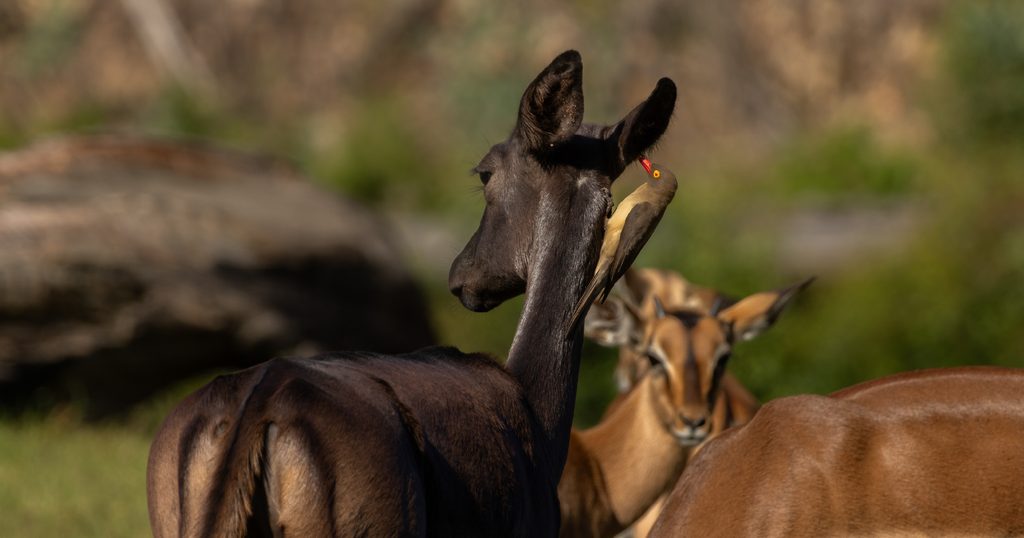
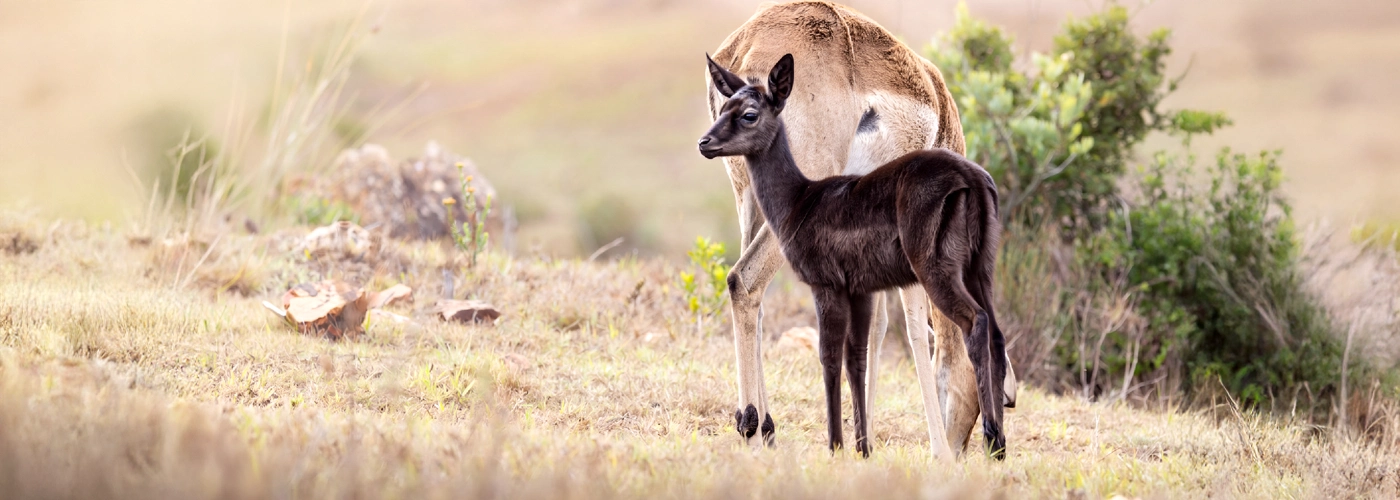
The black impala (Aepyceros melampus melampus) is a rare colour variation of the common impala, recognisable by its striking dark coat, white underparts and distinctive facial markings. Like other impalas, they are social and agile antelope, often seen moving in herds through open woodland and areas close to permanent water. Males have characteristic lyre-shaped horns, which curve upwards and inwards towards the tips, while both males and females are known for their impressive leaps when moving through the landscape or escaping predators.
Distribution: Eastern and Southern Africa
Size: Medium-sized antelope
Weight: Approximately 63 kg
Shoulder height: 83–96 cm
Horns: Males only; lyre-shaped and heavily ridged, curving upwards and inwards towards the tips
Habitat: Open woodland, particularly near permanent water
Against All Odds: the passion behind the black impala
In late 1975, Dr Dirk Neethling received news of an exceptionally rare black impala on a farm near Phalaborwa. Everything was prepared. The plans were in place, the equipment was ready, and the team was set to leave to dart and capture the animal. Then, on the very day they were due to depart, the phone rang. The black impala had been shot by a hunter who believed it was simply a freak of nature. The dream was over — for the time being.
For many years, the story fell silent. Then, in 1981, Dr Neethling heard of another black impala on a vast 17,000-hectare farm in the Waterberg. Before he could make the journey to investigate, however, the farm was sold. Undeterred, he contacted the new owner and explained his intention: to find the rare black impalas and, if possible, establish a breeding programme to preserve this unusual genetic colour variation. Permission was granted.
Together with veterinarian Johan Kriek, Dr Neethling set out by helicopter to search for the rare and elusive black impala across the expansive bushveld. They searched for 17 exhausting hours, but found nothing. With only an hour of daylight remaining, Dr Neethling suggested they call it a day. Johan Kriek disagreed. He insisted on making one final fuel run.
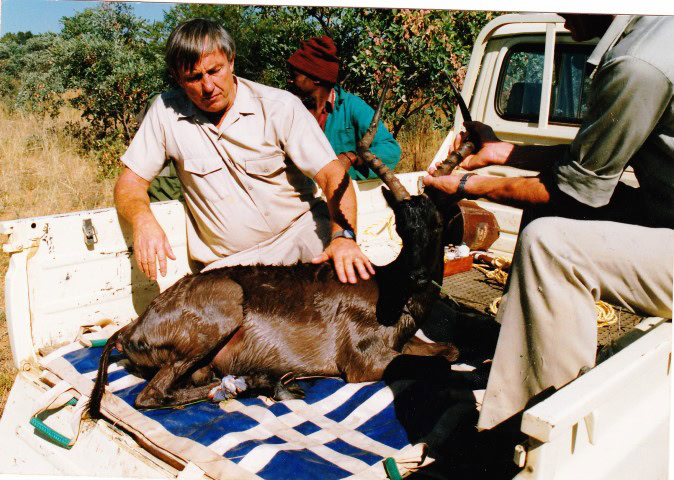
Less than three minutes after taking off again, they spotted him. There, in the bushveld below, was the black impala ram they had been searching for. After darting the ram, they began the journey back. With the ram on his lap came another extraordinary discovery: they spotted a black female that no one knew existed. Against all odds, they had found not one black impala, but a breeding pair.
A Decade of Patience
Those two animals became the start of a family breeding programme, built on patience, care and a goal to protect this rare colour form.
The black ram and black ewe were placed with 16 red impala ewes. During the first year, every lamb born was red, including the black ewe’s lamb. The following year, she produced a black ram.
Arnold was disappointed. He had hoped for a black female. But his father saw the importance of what they had. He told Arnold that having another black ram could actually be an advantage. A ram could breed with many females, making him extremely valuable to the programme.
Six months later, tragedy struck. Lightning killed the original black ram. Fortunately, the young black ram born the previous year was still alive. What had seemed like a disappointment had suddenly become a lifeline for the entire breeding programme.
For the next 11 years, through careful breeding, patience and meticulous observation, they gradually began to unlock the genetics behind the black colouration. What had started with an almost impossible search became a long-term family commitment to understanding, preserving and breeding these remarkable animals.
Eventually, the programme achieved its first major sales, with black impalas sold to Saudi Arabia. But the significance of those sales went far beyond the value of the individual animals. The income generated through the black impala breeding programme provided vital capital that helped establish and develop Botlierskop Reserve, while also supporting other conservation projects.
What began with a phone call in 1975, and a black impala lost to a hunter, ultimately became part of a much larger conservation story. It was a story of persistence, patience, tragedy, determination and extraordinary luck, driven by a deep commitment to conservation.